A short history of Grand Rapids, told through the river it almost lost
Updated August 2026
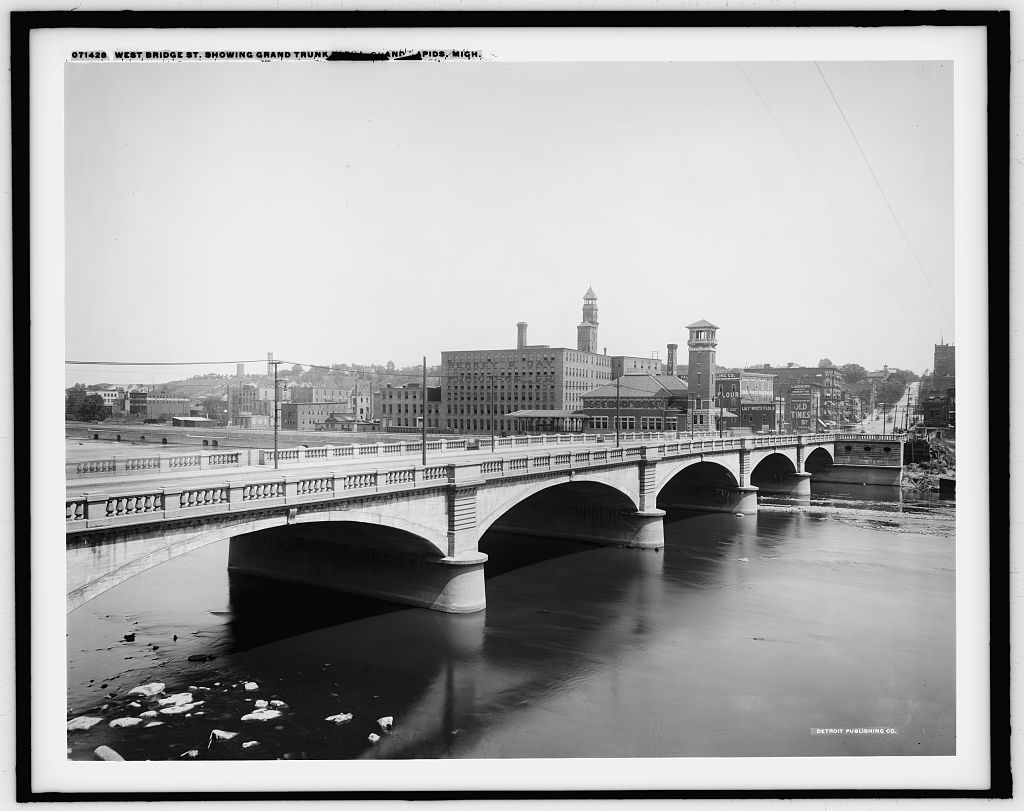
If you stand on the Bridge Street Bridge this month and look south, you will see something the city has not seen since before your great-grandparents were born.
Crews are pulling four low-head dams out of the Grand River. In-river work started on the first of July, after eighteen years of planning. As the water dropped, crews pulled up a slab of limestone cut with circles and flow paths — the first physical evidence of the original rapids anyone has found, still down there under a century of engineering.
The city named after rapids is getting its rapids back. What follows is how that took two hundred years.
Why there is a city here at all
There is a city here because the water was loud. The Hopewell could hear it.
They are considered the ancestors of the tribes Michigan knows today — the Ottawa (Odawa), the Chippewa (Ojibwa) and the Potawatomi (Bodéwadmi), who together called themselves the Anishinabek, "The Original People." Around 1700 they established villages in and around what is now Grand Rapids.
This was not a waypoint. Nineteen Ottawa chiefs governed the land along the river — which they called Owashtanong — from Lake Michigan to Lansing, and their largest village and main gathering place stood on the ground that is now downtown.
The rapids were the reason: the place you crossed, the place you fished, the place you traded.
Their descendants did not go anywhere. Four Native organizations operate in Grand Rapids today, and the pow wows on the calendar every year are not reenactments.
Five years after that treaty, in November of 1826, a fur trader named Louis Campau arrived with a government license to trade and built a log house on the east bank. He came for exactly the same reason as everyone before him.
When the land was finally surveyed, he was first in line. His patent came in October of 1833, and his land was bounded by Bridge Street — now Michigan — on the north, Division on the east, Fulton on the south, and the river on the west.
Lucius Lyon's patent came a month later, and the two men laid their land out differently — Campau following the old trails, Lyon on a surveyor's grid. You can watch them disagree on the 1836 village map, which the library catalogs specifically for "the difference in street layout between Campau's land and the rest of the village."
That seam never went away. It is why downtown streets still meet at odd angles, and why the oldest thing in Grand Rapids is not a building — it is an argument about what a city should look like, settled in the pavement, and you drive through the middle of it every day.
How Grand Rapids became Furniture City
What the rapids gave next was power. Power in the form of a river that carried timber.
Put those together and you get furniture. It was built by woodworkers from Germany, England, Scotland and Canada, and by newer immigrants from the Netherlands and Poland and African Americans who had come north from the South during Reconstruction. You still meet those surnames here.
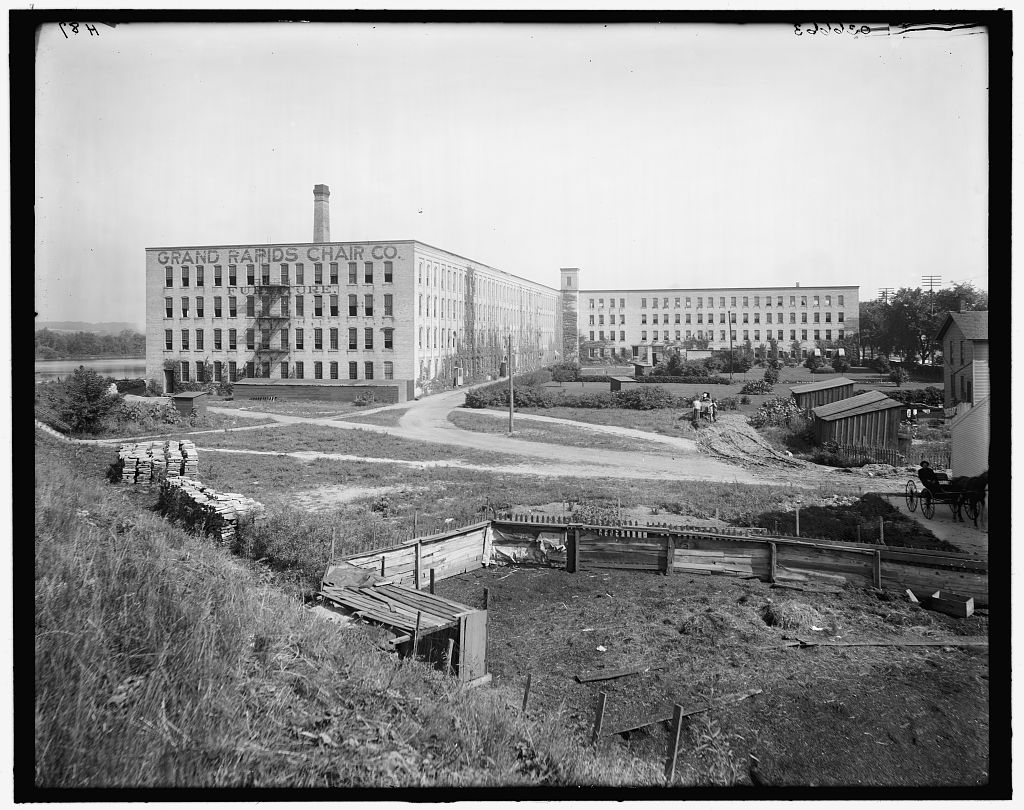
Getting at the power meant getting rid of the rapids, and the rapids were a set of limestone ledges the river ran over. So the people who lived here decided the river was the wrong shape. They dug canals, built dams, and hauled hundreds of tons of that limestone out — what the Public Museum calls a failed attempt to tame the rapids. By the late 1800s the water had gone quiet. The city kept the name and lost the thing it was named for.
What it got in exchange was the industry. The first furniture market was held here in 1878, and it worked well enough that the city started putting up buildings for no purpose but to hold it — exhibition halls through the 1890s and the first decade of the 1900s. Twice a year wholesale buyers came in from everywhere, because if you wanted a good piece of American furniture there was a strong chance it had been made within a mile of where you are standing.
It is easy to tell that as a straight success story. The people who built the furniture would not have.
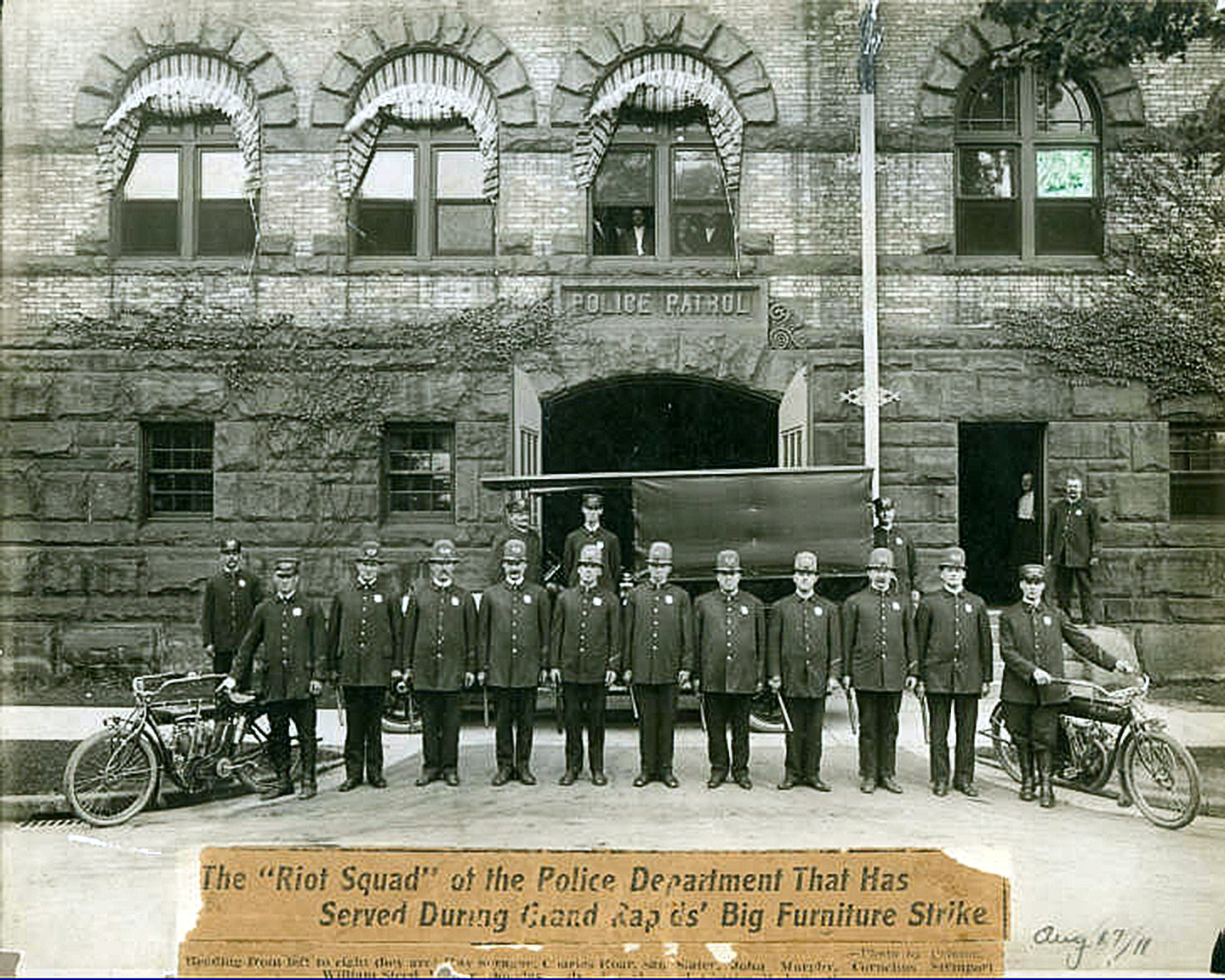
On April 19, 1911, somewhere between 4,000 and 6,000 furniture workers walked out. They had learned that the price of the furniture they made had gone up 10 percent, and wanted their wages to follow. The strike ran through the whole summer and ended in August. They did not get their demands. What they got was public sympathy — an estimated 10,000 people turned out for the Labor Day parade that year.
By 1925 the city had ten exhibition halls, and about 560 dealers were coming to The Market — nearly fifty years after the first one.
What replaced the furniture industry
The trade felt permanent right up until it wasn't.
The furniture recession arrived in 1926, three years ahead of everyone else's crash, and the Depression finished the job. Employment fell from 12,000 in 1929 to under 3,000 by 1940. North Carolina took the industry — cheaper labor, newer plants — and never gave it back. The rapids had been torn out to get that industry. Now the city had neither. That is where a lot of Midwestern cities stop.
The next chapter was already in the room, and nobody had looked up.
In 1912 — fourteen years before the crash, with the old industry still at its peak — eleven businessmen incorporated the Metal Office Furniture Company. It was built on Peter Wege's idea of making office furniture out of steel in a city that made furniture out of wood. Two years later it introduced a wastebasket.
Ultimately that company became Steelcase. Together with Herman Miller down the road in Zeeland, it made West Michigan the office furniture capital of the country and employed the region for the rest of the century.
The city never abandoned furniture. It changed which furniture. Same hands, same skill, different materials.
The turn after that did not come out of a factory at all. Rich DeVos and Jay Van Andel met at high school in Grand Rapids, and in 1959 they started a business out of their basements in Ada selling direct — a township whose history begins upstream on the banks of the Grand River. That company is Amway, and it made two of the largest fortunes in the state without making a stick of furniture. While those fortunes were being built, the same district kept sending one man back to Washington.
The president this district elected
The United States never voted for Gerald Ford. Grand Rapids did, thirteen times.
He was not born here. His parents separated weeks after his birth. His mother's parents lived here, so they settled in Grand Rapids. He grew up in the city. In 1948 Michigan's Fifth District sent him to Congress, and kept sending him: he served from January 3, 1949 to December 6, 1973, reelected twelve times, each time with more than 60 percent of the vote.
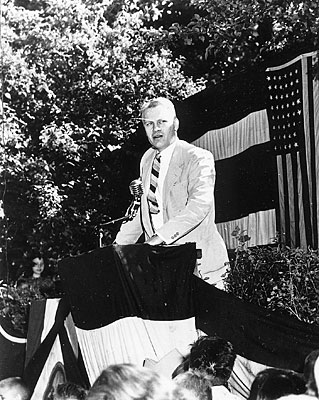
Then the strangest sequence in American political history ran straight through a Grand Rapids congressman. Vice President Spiro Agnew resigned in late 1973 over tax evasion charges, which empowered Nixon under the 25th Amendment to appoint a replacement. He chose Ford. Eight months later Nixon resigned to avoid impeachment, and Ford took the oath as the 38th President on August 9, 1974. He ran in 1976 and lost one of the closest elections in history to Jimmy Carter.
So he reached the White House without ever winning a national ticket. Every ballot that ever put Gerald Ford into office was cast here.
He came back, too. The Gerald R. Ford Presidential Museum sits on the bank of the Grand River in downtown Grand Rapids, and it is the final resting place of the President and Mrs. Ford. A president is buried on the bank of the river this city is currently rearranging.
Why the old houses are still standing
East of that grave is Heritage Hill, more than 1,300 historic properties in over 60 architectural styles — Greek Revival, Italianate, Queen Anne, Chateauesque, Shingle, and a Frank Lloyd Wright Prairie house built in 1908. It is one of the largest urban historic districts in the country. Built by lumber barons, Heritage Hill sits on a slight rise overlooking downtown. In the late 1960s the city recommended tearing down 75 percent of it.
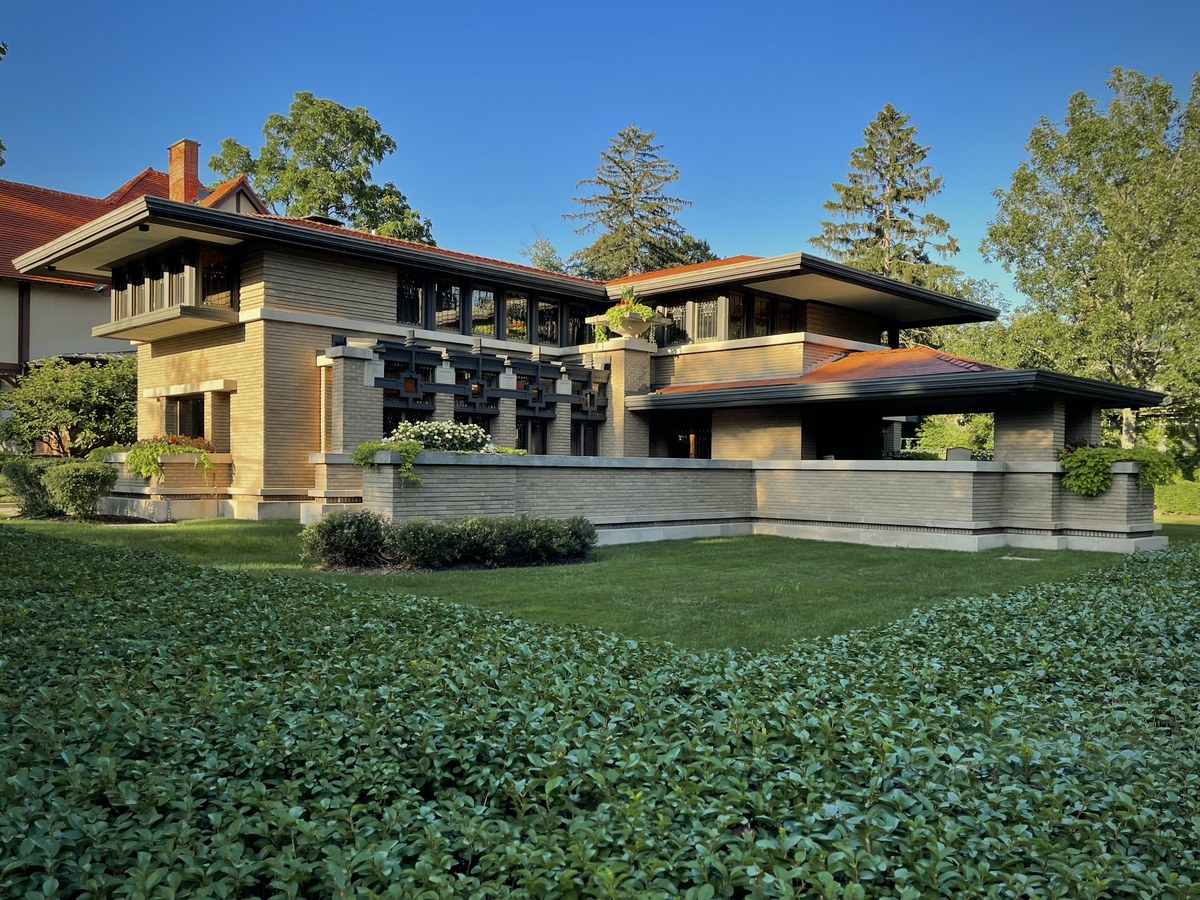
Urban renewal was the plan — a 1949 federal program that let a city buy up property whether the owner agreed to sell or not. It was meant to clear land for redevelopment, and Grand Rapids was not unusual in wanting it. What stood in the way was three women. In 1968 Linda DeJong, Barbara Roelofs and Ethel Hansma gathered 125 neighbors to protest the demolitions, and out of that meeting came the Heritage Hill Association. Two years later they stopped the demolition in court — the country's first successful challenge under the 1966 National Historic Preservation Act, and the first time anyone had used that law against a federal project.
Three quarters of that neighborhood is standing because three neighbors called a meeting. It is also why this city still has its nineteenth-century housing stock — a lot of American downtowns lost those blocks in exactly those years, and ours were argued for, one at a time, by the people who lived in them.
Where the money went
Michigan Street went the other way. In 1996 Jay and Betty Van Andel founded a biomedical research institute where houses, churches and small businesses had stood. It was Amway money. Ground broke in 1998; the doors opened in 2000. Billions have gone into that corridor since. Michigan Street is now the Medical Mile, running east from Monroe Avenue in the heart of downtown — a hospital complex, two medical schools, a research institute, and 55 medical device manufacturers across West Michigan. It is the same Michigan Street that was the northern edge of Campau's patent, back when it was called Bridge.
It was not the city's first bet on public health. In 1945 this was the first city in the world to fluoridate its drinking water — an experiment the rest of the country was still arguing about, which cut children's cavity rate by more than 60 percent before going everywhere.
Trading post, furniture factory, office furniture, a company run out of two basements, and a research corridor built with what that company earned. Five different ways of making a living here, roughly one per generation.
The years Grand Rapids bet on itself
In 2009 Michigan was on the floor. The auto industry was collapsing, foreclosure signs were an ordinary feature of an ordinary street, and people were leaving the state in numbers.
That year a Grand Rapids native named Rick DeVos announced an art competition where any artist could enter, any space could be a venue, and the public would vote. The reaction included the phrase Grand Rapids will become a laughing stock in the art world. It opened that September across 159 venues — museums, bars, laundromats, auto body shops — with 1,200 artists and more than 200,000 visitors. ArtPrize is now studied as a model for what art can do to a city.
That same year, a group of kayakers decided to reinvest in the river. That is Grand Rapids Whitewater, and what they wanted back were the rapids.
Worst year in a generation, and this city started an art festival and decided to un-dam a river.
Three years later it became Beer City USA, tying Asheville in an online poll and then winning it outright in a landslide. Neither that title nor the art prize was won by being the biggest city in the running. Both were won by turnout.
Then the poll ended. Charlie Papazian, who ran it, retired it after 2013, writing that it had "served its purpose" — which left Grand Rapids holding the title with nobody scheduled to take it. The city has been trading on it ever since: an ale trail, a brewery passport, a festival, nearly 40 breweries in the area today, and beer tourism worth $38.5 million to Kent County in a 2019 study.
What it feels like right now
All of that is record, something you can read on paper. What you don't get from paper is the energy in a city driven by diverse industries and the inflow of young professionals.
LinkedIn named Grand Rapids the number one "city on the rise" in its 2025 ranking of fastest-growing metros — a list of mid-sized places where more workers are moving in and hiring is accelerating. The region counted 597,000 employed residents in 2025, including 1,300 new tech jobs.
Tech now employs nearly 41,000 people here, the highest level on record. The river made the first fortunes in this city — timber floated down it, mills turned on it — and it has nothing to do with this one. The people doing this work can live wherever they choose.
They choose to live here because it is, as the screenwriter Adam Herz showed when he wrote his native East Grand Rapids into American Pie, the stuff of movies: Lake Michigan forty minutes west, and the dunes and the lakeside towns that come with it. More breweries than a city this size has any business having. An arena, a symphony, two theaters and a sculpture park you could spend a day in. Trails out of downtown. Farmers markets that are still actually farmers markets. A food scene that added the serious restaurants without losing the neighborhood ones.
That is what people mean when they say a mid-sized city throwing further than its weight. You get most of what you would move to a big city for, and none of what makes people want to leave one.
What the river is for now
I have lived in a lot of places, up and down the east coast.
Every city sells you a snapshot — the photos, the restaurant list, the walkability score. What history gives you instead is a direction. This city has rebuilt itself about once a generation and kept the houses other cities knocked down.
Two hundred years ago people came to this spot because the river was useful. Steelcase, Amway, a president, a medical corridor and 41,000 tech jobs all came out of this place. Those kayakers started in 2009, and this month the rapids began going back in — only this time nobody is putting them back to run a mill or float timber. The city is spending millions to make the river a better thing to live beside. The rapids will be back in a few years.
The people of Grand Rapids have been here the whole time.
Come meet them.
Curious about a particular corner of it? The Saturday and Sunday posts are what an ordinary weekend actually looks like here, and Events in GR is what's on this month.