
← All Grand Rapids neighborhoods
Grand Rapids, Michigan
Heritage Hill
The city's first historic district — around 1,300 houses on the rise east of downtown, where the outside of the building is not entirely yours to change.
- Size
- 0.48 sq mi
- city boundary
- Built
- 1843–1925
- lumber and furniture money
- Residents
- 4,500
- approximately · 2020 census
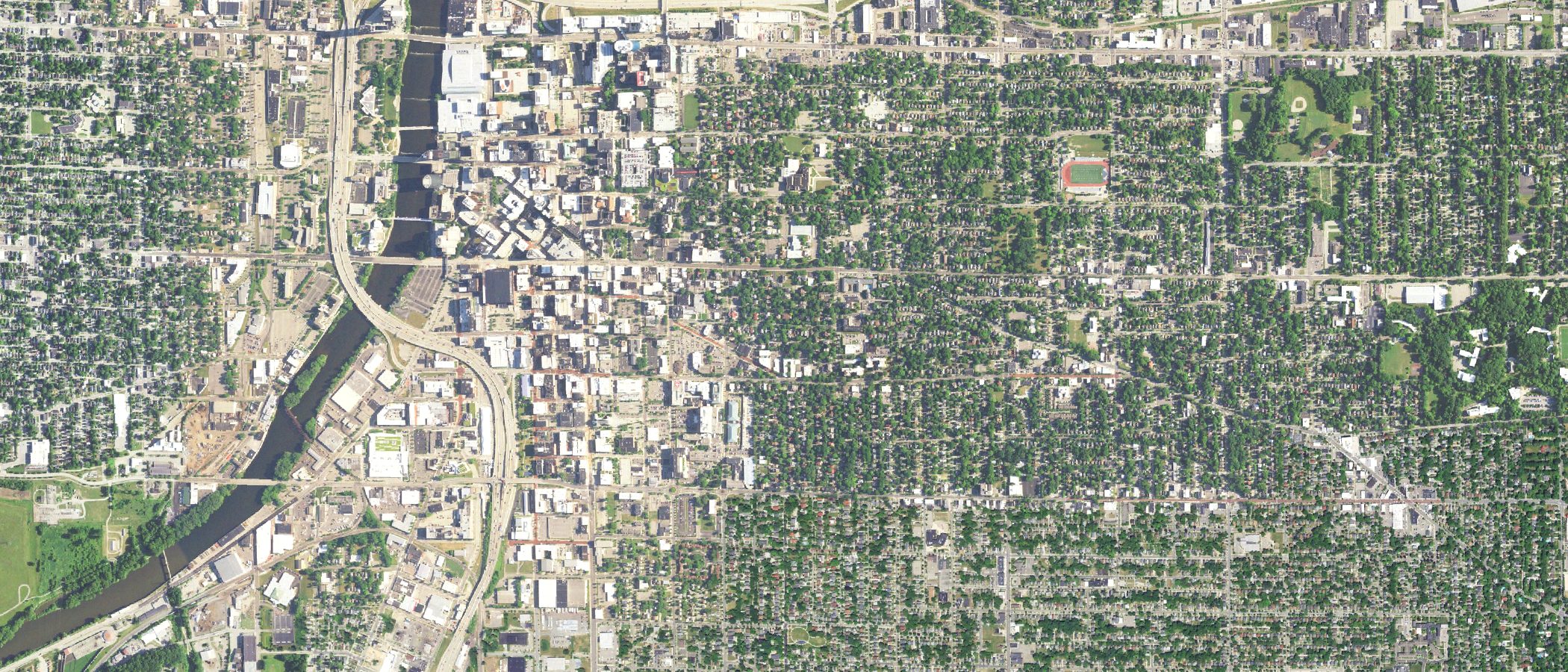
Heritage Hill is outlined by Crescent Street to the north, Union Avenue to the east, Pleasant Street to the south, and Jefferson Avenue to the west. Immediately east of downtown. Close enough that people walk to work on the Medical Mile or to explore downtown any night of the week.
What it’s like
Heritage Hill is the walk-to-downtown option, and it looks like nowhere else in the city — thirteen hundred houses on a rise, porches close to the sidewalk, sixty-odd architectural styles on the same street. It is a working neighborhood rather than a preserved one: people mow these lawns and argue about parking. Downtown is ten minutes on foot and the Medical Mile is closer than that, which is why you see people walking to work here in a way you do not in most of Grand Rapids. The trade is that the outside of your house is reviewed before you change it.
Eat & drink
A step back into the 70s. American fare with a vibe you won't forget. Try a little bit of everything — but debatably the best wings in town.
Try to find a Chinese eatery you'll enjoy more than Beijing Kitchen. If you're a fan of Chinese food you'll want to come back for more. 342 State Street SE.
Also here
Frank Lloyd Wright designed it in 1908 for a Grand Rapids clothier, and Steelcase bought it in 1985 and put it back exactly as he left it — the most complete Wright restoration anywhere. Tours are free, small, and by appointment. Give it ninety minutes and you'll walk the rest of the street differently.
- Foster Park
The centerpiece of this small triangular park is a copy of a statue named The Hiker, sculpted by Theo Alice Ruggles Kitson. It's not easy to feel secluded in the middle of a city, but that's exactly how you'll feel. Curl up on a nice spring or fall day with your favorite book.
- Caulkins Law Office · Museum
- Dog Story Theater · Theatre
- Heritage Hill Park · Park
- Lincoln Place Park · Park
- Mooney Park · Park
Getting around
- Downtown
- Walking distance — the western edge is a few blocks from Monroe Center.
- Medical Mile
- Michigan Street runs along the north side, so the hospitals and research buildings are a walk rather than a commute.
- On foot
- The grid is tight and the sidewalks are continuous, which is what happens when a neighborhood is built before cars and then never rebuilt for them.
The homes
- Italianate · 1840s–1920s
- Queen Anne · 1840s–1920s
- Stick · 1840s–1920s
- Shingle · 1840s–1920s
- Prairie · 1908, the Frank Lloyd Wright house
Around 1,300 houses and more than sixty styles, which is the part worth walking: Stick beside Shingle beside Italianate, and one of Frank Lloyd Wright's Prairie houses, finished in 1908, sitting in the middle of it. Largely single-family, with a share of the larger houses divided into flats during the decades when that is what kept them occupied and standing. The designation is the part that changes what ownership feels like: additions, alterations and repairs need a Certificate of Appropriateness from the Historic Preservation Commission, and that comes before the building permit, not after it. One caution about size: the figure in the table above is the city's neighborhood boundary, which is not the historic district. The two are drawn differently, and the National Register boundary was extended in 1976 to take in the 600 block of Union. Which of them your address sits inside is what decides whether the commission gets a say in your porch, so it is worth checking rather than assuming.
Built with lumber and furniture money either side of 1900, and still standing because neighbors stopped a demolition plan in 1971. The longer story.
Lately from the neighborhood
- October 17 | Dumpster DayOctober 15, 2026
- October 19 | Heritage Hill Neighborhood Input Meeting: Proposed Corewell Butterworth ExpansionOctober 15, 2026
- October 21 | Haunted Heritage Hill: Cocktails & CuriositiesOctober 14, 2026
Posted by Heritage Hill Association, not by me — I just point at it.
The people who actually live here
Heritage Hill Association knows things about Heritage Hillthat I don’t, and answers questions I can’t.