
August 24, 2026 · Nate Love
Moving to Grand Rapids: cheaper than where you're coming from, and four times tighter
For buyers · For investors · Relocating
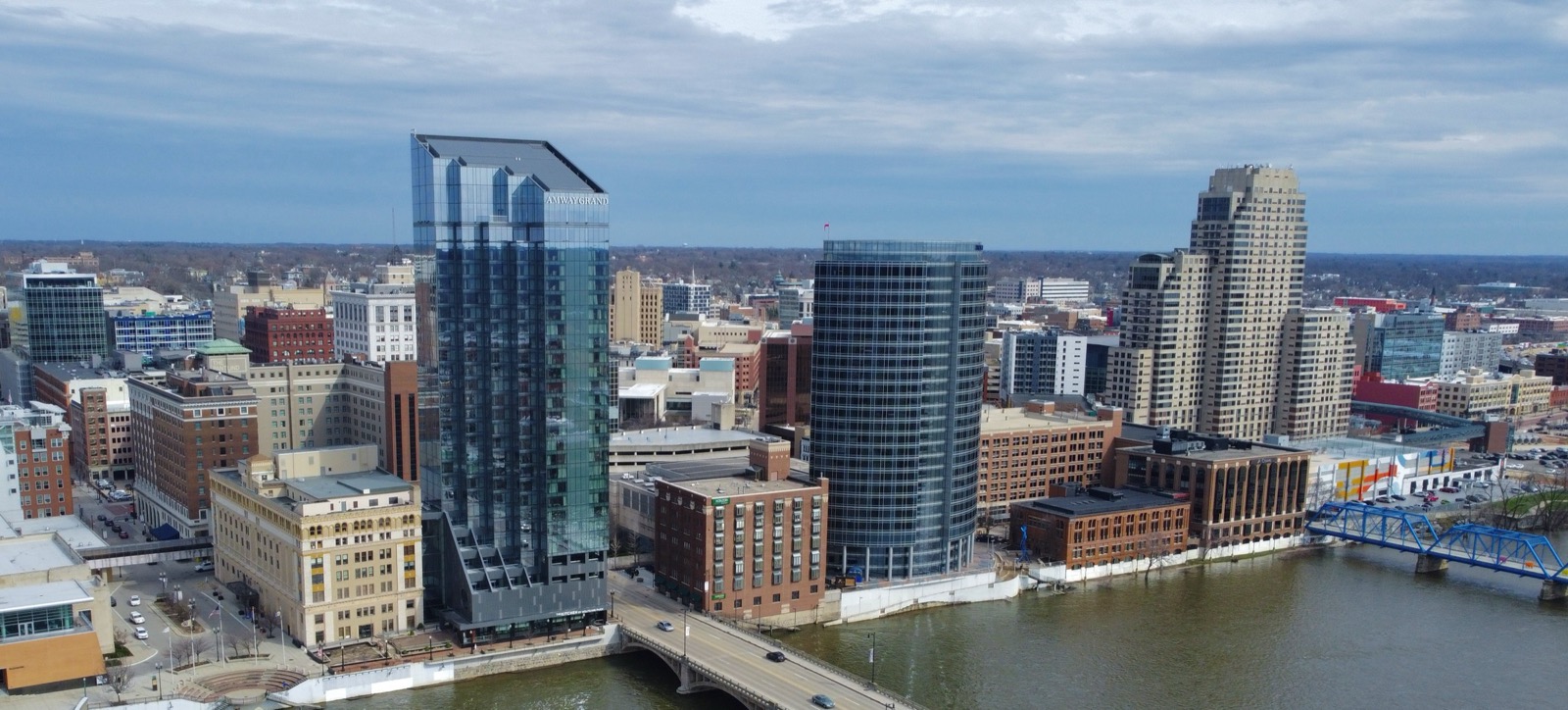
Most people move somewhere cheaper and assume the trade-off is obvious: your money goes further, and in exchange you give up jobs, or things to do, or both.
Grand Rapids doesn't work like that, and the reason is worth understanding before you plan a move.
What you're moving to, next to what you're moving from
Grand Rapids
June 2026
Median home price
$334,950 — city median
Months of supply
1.1 months — Kent County
Days on market
19 days, Kent County
Unemployment
4.0% — metro
The U.S. overall
June 2026
Median home price
$440,600 — national median
Months of supply
4.6 months
Days on market
28 days, national median
Unemployment
4.2%
Read that table twice. The median home in the city runs about 24% below the national median — and Kent County has about a quarter of the national inventory, moving about a third faster.
Those two facts don't usually travel together. Cheap markets are normally cheap because supply outruns demand — more houses than buyers, prices soften, homes sit. Here you get the lower price and the scarcity, which is not a bargain so much as a queue. You're not arriving somewhere overlooked. You're arriving somewhere a lot of people have already found, where the price hasn't caught up yet.
The economy people don't expect
As of June 2026, metro Grand Rapids unemployment sat at 4.0%, against 5.0% for Michigan as a whole and 4.2% nationally. A full point below your own state is not a rounding error. It's a different labor market inside the same borders.
What actually pays the bills here
Manufacturing, still
About 18% of metro jobs, more than double the national share. Office furniture built the city and the sector never left — Steelcase alone has been headquartered here since 1912.
Health care and education
Roughly 17% of jobs. Corewell Health is headquartered on the Medical Mile downtown and is the largest health system in Michigan.
Professional services
About 13%, and the fastest-moving of the three. The region added roughly 1,300 tech jobs in 2025 alone.
No single point of failure
That's the part that matters if you're moving a household. No sector here is much above a fifth of employment, so one bad year in one industry doesn't take the whole metro with it.
The diversification matters more than any of the individual names. Plenty of Midwestern metros have one dominant employer and a story about resilience; this one has actually rebuilt itself about once a generation. In Grand Rapids, the employer roster is deeper than the city's profile suggests. Amway in Ada, Meijer in Walker, SpartanNash in Byron Center, Wolverine Worldwide in Rockford, Steelcase and Corewell Health in Grand Rapids proper — all headquarters, not branch offices.
So the question when you're moving a household here becomes whether the second and third industries are big enough to catch you. If the job you came for ends, that's the difference between finding another one here and moving your family again.
The number that connects the jobs to the houses
What people earn here, and what a house costs here
Household income is nearly identical to the national figure. The price of a house is not.
A household in Kent County earns $80,685 at the median. The national figure is $81,604. For practical purposes the same number — you are not taking a pay cut to live here. What changes is the other bar: the house costs about a quarter less.
That's the whole affordability story, and it's simpler than most versions you'll read. Your income doesn't shrink when you move here. Your housing cost does.
(Measured inside the city limits, median household income is lower — $70,515 — so the gap narrows if you'll both live and earn within the city proper. The county figure is the better guide for most households relocating for work.)
This says something durable about the market itself: local wages here can carry local prices. Places get into trouble when prices float away from what the people there actually earn. West Michigan's haven't — which is a quieter thing to say than "prices are up," and a more useful one.
People are already moving here
Between 2020 and 2025, Kent County added close to 17,000 residents — the largest raw gain of any county in Michigan, about 2.5%. West Michigan as a region added more than 43,000. In a state that spent decades losing people, one corner of it is absorbing them.
The institutional money is moving the same way. The Right Place, a regional economic development organization, reports helping create or retain 4,153 jobs over its last three-year plan at an average wage of $30.90 an hour — about $64,000 a year at full time — alongside $844.2 million in new business investment and $487.2 million in community development projects.
You can see where a chunk of it went downtown. The Acrisure Amphitheater — 12,000 seats, $184 million — opened on the riverfront in May. Two blocks away, Amway Stadium is going up as an 8,500-seat soccer venue, with AC Grand Rapids starting play in 2027. A mid-sized city building two purpose-built venues at once tells you what its leadership expects the next decade to look like.
The part that isn't on a spreadsheet
Frederik Meijer Gardens & Sculpture Park is 158 acres of botanical garden and outdoor sculpture, and it drew 881,625 visitors in 2025. USA Today readers voted it the country's best sculpture park three years running, 2023 through 2025.
ArtPrize takes over downtown September 18 to October 3 — storefronts, parks, museums and breweries all become venues, over $400,000 goes to artists on public and juried voting, and it costs nothing to walk through. If you're deciding whether to move here, that's the week to visit.
The beer thing isn't just marketing. Grand Rapids won a national "Beer City USA" vote in 2012 and has been named America's best beer city by USA Today readers every year since 2021 — six straight, most recently this March. The Ale Trail lists more than 80 breweries.
And the city shows up for sport. The Meijer LPGA Classic ran its twelfth year at Blythefield this June. The Beer City Open brought Major League Pickleball's midseason tournament to Belknap Park in July: 21 courts, all twenty pro teams, $200,000 in prize money, and roughly 1,200 amateurs from more than ten countries playing alongside them. Come fall, a football Saturday here reorganizes the whole week around it.
Then there's the water. A city on a river, forty minutes from Lake Michigan, with Grand Haven, Holland and Saugatuck close enough to be a Saturday rather than a vacation.
Two things that will cost you money if nobody tells you
The pace. If you're coming from a market with four or five months of supply, your instincts are calibrated to a world where you see a house on Saturday and think about it until Wednesday. At 1.1 months and nineteen days on market, it's gone by Tuesday. That 1.1 is a county-wide average, though, and it holds best in the busiest price bands — above $700,000 there is meaningfully more room, which is worth knowing before you calibrate to the wrong market.
The fix isn't moving faster once you're here. It's to condition yourself to the market before you're in it. The slow work first — lender conversation, pre-approval in hand, your ceiling and your must-haves written down. Then the calibration: see what houses actually look like at your price point, whether that's $300,000, $500,000, $1M, or $1.5M. That way the price bands mean something to you before you're standing in one with two other cars in the driveway. A buyer who has already studied twenty homes recognizes the right one in an afternoon; a buyer who hasn't is still learning the market while it moves.
The tax number on the listing is not your tax number. Michigan resets a home's taxable value the year after it sells, so a seller's advertised figure can have little to do with your second-year bill. One free call to the local assessor settles it, though knowing which number to ask for helps before you dial.
What I won't do, and what I'd rather do instead
Relocation guides usually sort you into a neighborhood based on what kind of person they've decided you are. I don't — and not only because steering on the basis of who lives somewhere runs into the Fair Housing Act's prohibition on making housing "unavailable" by protected class and Michigan's Elliott-Larsen Civil Rights Act. It's also worse information. My criteria aren't yours.
What I'd rather do is be more intentional about it. That starts with getting to know you: what your days look like, what the commute has to be, whether you need a yard or a spare room that becomes an office, what you'll trade and what you won't.
It also means handing you the tools instead of the conclusions. The assessor sets the millage rates. The state school portal has the performance data. The township planning department knows what's approved to be built next door. All of it is public, all of it is in the relocation guide with links, and you can work through it before we've ever spoken. You should be able to answer these questions without me.
Then we get to the part I love: taking everything you've decided matters and finding the property that meets it, at a price and in a place that makes sense.
The take-home
Grand Rapids is cheaper than where you're coming from and harder to buy in, at the same time. Plan for the second one and the first takes care of itself.
Start the lender conversation while you're still just looking, and I'm happy to connect you with people who do it well. Come for two full days when the city is showing off — the Beer City Open in July, ArtPrize from mid-September. Condition yourself to the price bands before you're bidding in one. And get the uncapped tax figure on anything you're serious about before you write.
Send me a message if you're working through a move to West Michigan — including if you just want help planning the trip and deciding what's worth your two days. The most useful conversation is usually the early one, months out, when there's still time to change the plan.